

Tenerife 2026: Absolute Darkness, a Fogfall, Haze and One Very Unhappy Leg

“This is something I should have done a long time ago,” flashed through my mind as I stared up at thousands upon thousands of stars in a perfectly dark sky.
I had never really gone abroad on a purely photographic trip on my own. It was always either part of a regular holiday or I was travelling with friends. This time, I had the opportunity to make use of some unexpectedly available free time, so I thought, “Why not?”
I had several destinations in mind, but since I would like to get into astrophotography in the future, the shortlist eventually came down to Madeira and the Canary Islands. In the end, Tenerife won.
It’s not that I didn’t like Madeira. Quite the opposite. We travelled all over the island years ago and I came back with plenty of photographs I still love going back to. But Tenerife was calling me a little louder. I had never explored the northeastern tip of the island, with Anaga Rural Park, at all. The plateau around Mount Teide offers perfect conditions for astrophotography, and I had already brought home a huge number of photographs from there on my previous visit that I still enjoy looking at.
“Five nights should be enough,” I told myself, and started looking for flights around the new moon, when the night sky would be as dark as possible.
I studied maps and photographs from various places and worked out where I would go each morning and evening. Originally, I had also planned to stay somewhere where I would cook all my own meals, but my wife’s comment that there was nothing better than coming back from a sunrise shoot to a ready-made breakfast sent me in a slightly more comfortable direction.
A hotel in Puerto de la Cruz seemed like a good base. Not far from La Orotava, where the road up to Teide begins, and close to the ring road, meaning I could get to Anaga in about 40 minutes. On top of that, the hotel had a huge garden and a swimming pool where I could recharge both mentally and physically.
Everything sounded great.
I had several goals. Apart from the astrophotography I mentioned, where I wanted to see what truly dark skies actually looked like, I had a composition in mind of the Milky Way with Roque Cinchado. I was hoping for a shot of Teide sticking out above a sea of clouds, wanted to add another long-exposure seascape to my collection, and also wanted to see at least one sunrise...
My late-afternoon arrival, picking up the rental car and driving to Puerto de la Cruz took longer than expected. By the time I reached the hotel, golden hour was already getting underway. Luckily, I had been given a free upgrade to a room with an ocean view, so I grabbed a few shots of the golden cliffs.
I didn't know the area at all, so all I could do was thank the photographic gods for the well-positioned room and start planning the next few days.
Day 1
My first destination was Anaga, the laurel forests in the northeast of the island, with an almost mystical atmosphere.
The weather wasn't exactly helping. At most viewpoints, I spent most of my time staring into the fog, although that actually added another layer to the experience. The only really unpleasant thing was the strong, gusty wind. On the other hand, I was hoping it would mean clean air for the night's photography.
I also stopped at the information centre to ask for some photography tips. A very nice gentleman enthusiastically described a whole bunch of beautiful places, handed me a map covered in his notes and added that I shouldn't leave the trails because it was forbidden. :)
On Friday, the place that caught my attention most was Tunel de las hadas, a path cut into the rock near Pico del Inglés. It took a little patience before I could photograph it without tourists, but the result was worth it.
Continuing east, the skies became more broken and offered some beautiful views all the way down to the Auditorio de Tenerife in Santa Cruz.
At one viewpoint, I noticed a little restaurant, stopped for lunch and, with an amazing view, tried one of the Canarian specialities: Carne de cabra, a heavily spiced goat-meat stew.

Nobody was particularly interested in speaking English with me, and my two semesters of Spanish fifteen years ago are buried pretty deep under layers of dust by now. Luckily, with the help of a couple of guys at the next table, we somehow managed to communicate. They even gave me several tips about nice places to visit and insisted I absolutely had to go for a meal at Casa Paca...
I continued on, deliberately skipping the turn towards Benijo so I could get through San Andrés and Santa Cruz and into Teide National Park as quickly as possible. Time to start planning the evening shoot...
The weather was perfect today. Thanks to the wind, the sky was completely clear, while the clouds had become stuck on the northern side of the island. I could simply choose where Teide looked best.
I checked out several viewpoints and short trails, had a look at a spot for my first night-time astro experiments and then headed back to Mirador de Chipeque, where the view was the nicest.
I expected there to be a lot of people. After all, one of the reasons I love photographing sunrises is that not many people are willing to get up for them. :)
But what I found was something I really wasn't expecting.
I parked about 300 metres from a viewpoint absolutely packed with locals, and more and more people kept arriving. The problem was that there was no chance whatsoever of setting up a tripod, so after a short deliberation I called a retreat and started looking for Plan B.

By the time I was leaving, the line of parked cars was already more than a kilometre long (!) and people were still arriving.
Well, Friday night.
There were cars parked all along TF-24, too, with locals sitting beside them on camping chairs, enjoying the beautiful view over a picnic.
I drove a few hundred metres further to a less accessible viewpoint, with a slightly worse composition than the local Teide for People festival, or whatever we should call the crowds at the previous place. There were only about twenty people there.
Even so, finding a suitable spot wasn't easy. A couple of people in front of me even managed to stand directly in front of my lens several times and start taking selfies.
Well, let's be honest. A grey-haired photographer probably didn't exactly fit into the romantic Friday-night atmosphere for the younger crowd.
I didn't care. I wanted to see the sunset with Teide above the fog, and that's exactly what I got.
As blue hour slowly started to fade, I continued west to a spot I had picked out for night-sky photography.
Equipped with a headlamp with a red light and a winter jacket, I found a spot sheltered from the wind, pulled out my gear... and spent about half an hour trying to get the tripod head working, only to discover that I had connected one of the USB cables incorrectly.
Damn. Who is supposed to see that in the dark, and why are there like five USB ports here? :D
And then I just let the camera do its thing and enjoyed the view.
I don't know how many of you have ever been somewhere with truly dark skies during a new moon, when the centre of our galaxy is visible overhead.
I hadn't.
I wasn't really sure what to expect. I knew it obviously wouldn't look like it does in a photograph, but I also knew it was going to be pretty damn impressive.
And it was. :)
Back home in the Vysočina region, I've experienced some genuinely dark nights, especially in autumn, but the Milky Way had always looked like a rather faint mist in the sky to me.
Here?
I could see the actual dark patches you see in photographs, countless stars everywhere and absolute darkness.
Although, I have to admit, I might have expected the darkness to be just a tiny bit... darker. I don't know. :)
For me, the experience was comparable to seeing the Northern Lights. They don't look nearly as bright in the sky as we can make them look in post-processing either.
I sat on the rocks for a good two hours, experimenting with settings and praying that I had actually aimed at Polaris correctly. :D
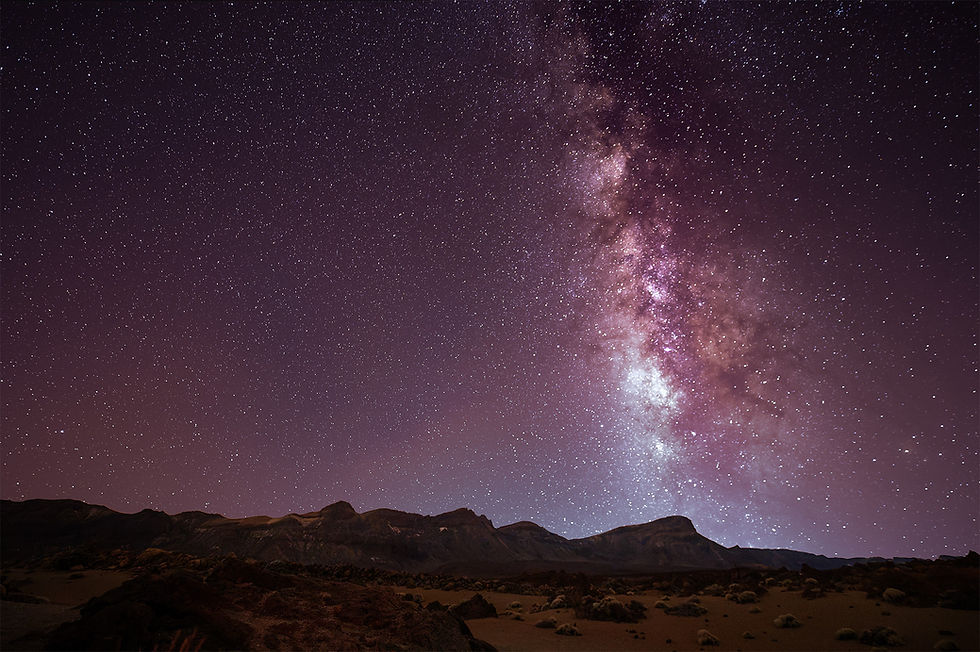
Around half past midnight, when the centre of the galaxy started disappearing below the horizon, I packed up my gear and headed north.
An hour of driving through the mountain serpentine roads was a long one, but I was so full of what I had just experienced that I barely noticed.
About halfway there, I stopped once more. I had noticed clouds above the northern coast of the island, lit from below.
At the viewpoint, I met another crazy photographer, taking pictures of the scene on his phone. He was coming back from a night trip to the summit of Teide and simply couldn't get enough of the night.
Neither could I.

Back at the hotel, I opened a can of Dorada before going to bed and then couldn't fall asleep at all, my head still processing everything I'd just experienced.
Day 2
The late night and the exhaustion from travelling had taken their toll on my motivation.
I decided to relax with a book in the hotel gardens and perhaps take a little walk around Puerto de la Cruz.
The weather wasn't helping either. An unpleasant haze had settled in. According to the webcams, it wasn't just along the coast but also in Teide National Park, so another astro session wasn't looking particularly promising.
There was a well-rated little restaurant not far from the hotel, so I stopped there for a late lunch during my walk and tried the local Carne de fiesta with garlic aioli.
On my way to a nearby beach, I said hello to a group of red crabs hanging out on the rocks and tested the temperature of the ocean.
More than pleasant!
As evening approached, I spent quite a while thinking about where to go.
The haze had turned into heavier clouds in places, but according to the webcams, that was only happening along the northern coast. Elsewhere, there was still thick haze.
I was already in the car, thinking I would go and investigate, when it occurred to me that the photographic gods were once again pointing me in the direction I was supposed to go.
To understand this, you need to know that parking in Puerto de la Cruz was no fun at all. But on my way back at night, I had managed to find a spot right by the road leading down to Playa de los Roques.
The beach was officially closed, but a local guy told me that people went down there all the time, as long as you were careful for about two metres of the path.
And then it clicked.
Why would I walk all the way around when I had hiking boots in the car, right next to the path down the cliff?
I changed shoes, climbed through the barrier that apparently everyone ignores anyway, and calmly made my way down to the beach.
Two huge rock formations were sticking out of the ocean, one of them with an actual hole right through the middle.
Absolutely brilliant.
I pulled ND filters out of my backpack so I could smooth out the waves with a longer exposure while also conveniently erasing a group of young guys surfing between the rocks, and started looking for the best compositions.
Unfortunately, the tide was near its lowest point, so the nicest rocks were completely dry. The clouds also meant there was absolutely no chance of decent light.
At least I got to experiment with reflections in the wet black lava sand.
On my way back to the hotel, I saw fireworks in the distance and took them as a hopeful sign that perhaps the conditions would finally start improving over the next few days. Unfortunately, that turned out to be wishful thinking.
Day 3
Another morning greeted me with thick haze, promising yet another hot day.
The YR.no app insisted there should be a northerly wind of 8 metres per second, but in Puerto de la Cruz not even a leaf was moving.
Today's destination was Anaga again. This time I wanted to drive all the way to the northeast, to Playa de Benijo, and see whether it might be a good place to photograph sunset, either that evening or the next day.
On the way, I stopped again at Mirador de Jardina and Mirador Cruz del Carmen, where on Friday there had been nothing but fog and I couldn't see further than the end of my nose.
And then it hit me.
I had to come here for sunrise.
I still had two days left, so surely I'd get the chance.
I continued northeast and suddenly felt as if I had driven into a completely different part of the world.
Memories of lush green Madeira came rushing back, and I fell even more in love with Tenerife.
The drive past Playa del Roque de las Bodegas and Playa de Benijo towards the village of Benijo, where I wanted to have lunch based on a recommendation, showed me that this was a popular part of the island even with the locals.
Parking was practically impossible. Most of the cars weren't rental cars either. They belonged to locals.
Eventually, I found a spot with an amazing view. Since I wasn't hungry yet and had nowhere else to be, I sat down on a rock with my book and alternated between reading and staring at the landscape.
I decided to stay for sunset.
The idea of silhouettes of huge, jagged rocks lit by golden sunlight sounded more than appealing.
I never made it to Casa Paca for lunch because that place was packed too.
Instead, I had lunch at Restaurante Los Roques Casa Pepe: excellent pork tenderloin steaks with a selection of mojo sauces.
Then I waited for sunset.
The restaurant officially closed at 5 pm, but I wasn't in a hurry and nobody was throwing me out. They even offered me a homemade chocolate dessert, which I couldn't resist.
The hot weather then tempted me to go and play in the waves for a while, hoping that nobody would feel like dragging my backpack full of camera gear away over the slippery pebbles.
After getting thoroughly soaked and basically marinated in seawater, I went back to reading on the beach.
That's when clouds started appearing in the sky.
And not the thin little clouds that might produce nice colourful skies.
Proper, heavy clouds that bring nothing but grey.
I hesitated for a moment, but the decision didn't take long.
I couldn't stay here.
I packed up my gear and moved on, looking for another location. Mirador de Jardina promised a sunset with Teide, and if the clouds were sitting in the valley there too, it could be more than beautiful.
I was in a hurry, which inevitably meant getting stuck behind a slow-moving car, soon followed by a respectable queue of cars.
I was driving through a bend with a viewpoint when I glanced left and caught something incredible out of the corner of my eye.
Fog rolling over a mountain ridge.
I couldn't stop. The cars behind me were moving too fast. So after a few hundred metres I turned around at a lay-by and drove back.
“Why the hell is nobody stopping here?” I thought.

I didn't care that my swimming trunks were still wet. I quickly put on a hoodie and grabbed my tripod and bag of ND filters.
“I need to blur this!”
While the Nikon was shooting long exposures, I recorded videos on my phone and tried to make a timelapse, which really deserved its own tripod.
Never mind.
Gradually, other people started noticing me, stopping and joining in.
I photographed as much as I could. I kept thinking that with better light, this would have been absolutely spectacular, but I suppose you can't have everything.
As the falling fog started turning increasingly grey, a cheerful, long-haired guy arrived on a blue scooter with his girlfriend sitting behind him.
He told me I should drive to the village of Taborno because it was even more beautiful there.
I was about ready to pack up anyway, so I took his advice and continued.
I didn't find another fogfall there, but I did find the sun setting behind mountain peaks emerging from the misty landscape.
I parked in the only possible place, next to a house on the slope.
As I pulled out my tripod, an older woman started waving angrily at me from the window.
In my very broken Spanish, I asked her if she could let me stay there for four minutes.
She waved her hand and reluctantly agreed.
I managed to get a few shots and thought it was a bit of a shame I hadn't arrived earlier.
But I simply couldn't leave that fogfall.
I wasn't going to Teide anymore. It was already too late and I wouldn't have made it there sensibly, so I headed back to the hotel.
I drank a can of Dorada Especial beer on the terrace, made a quick backup of my photos and collapsed into bed.
Tomorrow, I had to get up early...
Day 4
This time I didn't chicken out.
With a clear plan in mind, I got up when the alarm went off and headed out.
I arrived at Pico del Inglés at 7:30, about twenty minutes before sunrise.
On the way, I met two girls heading in the same direction, and at the viewpoint I bumped into a Polish couple. We chatted for a while as I unpacked my tripod.
In front of me was absolute paradise.
On the left, the misty mountains and cliffs of the northern coast. On the right, beautiful silhouettes and a view of the ocean.
I photographed the rocks with a long exposure and an ND filter, then took the filter off and enjoyed the sunrise with a longer lens.
The sun once again rose into fairly heavy haze, but this time it wasn't as high as on the previous days, so after a few minutes the landscape was flooded with golden light.
I turned around and photographed the illuminated volcano Teide towering above the landscape, then turned back towards the fog.
I alternated between wide-angle shots and long-lens compositions, wishing the golden hour would last just a little longer.
Unfortunately, it didn't.
I stayed anyway, took a banana out of the car and had breakfast with a view of all that beauty.
Normally, I'd bring a thermos of tea and some breakfast for a sunrise shoot, so I could sit there afterwards, enjoy the view and have a peaceful breakfast.
This time, however, I felt sorry for the fresh omelette waiting for me at the hotel.
So as the first tourists started arriving, I left Anaga and headed back towards Puerto de la Cruz.
“Monday has started beautifully,” I thought.
“I'll take it easy during the day, maybe go to the beach for a while, and in the evening I'll drive up towards Teide for some sunset shots. I'll come up with something...”
Unfortunately, just as beautifully as Monday had started, it went downhill.
Which is, I suppose, something Mondays are particularly good at.
At the beach, I went into the sea when, at the worst possible spot, a much bigger wave arrived than any of the ones before.
It knocked me down and tossed me around a bit.
I got up, turned around and...
BANG.
Another one. Even bigger.
Unfortunately, I was standing on a slippery rock. My foot slipped and twisted badly.
I picked myself up, limped back to my towel and immediately knew this wasn't good.
I won't go into the details. Instead of a relaxing afternoon, buying presents for the kids and another trip to Teide National Park, I got to experience the emergency department of a local hospital.
I didn't want to risk any complications, so the evening photography session took place from the terrace of my hotel room.
Which, incidentally, was also where my short stay on Tenerife had begun.
Day 5
I gave up on the morning shoot too, considering the state of my leg.
Although, judging by the conditions, there wouldn't have been much worth photographing anyway.
The haze was awful again. Looking out of the plane on the way home, I could see that even Teide itself was completely hidden in it.
And so I drove to the airport, returned my rented Opel Corsa, in which I had covered almost a thousand kilometres, and headed home to Posázaví and my family, who were surely already looking forward to seeing me.
Just as much as I was looking forward to seeing them.
On the flight, I enjoyed a beautiful sunset over the Atlantic, wrote these lines and looked forward to adding the photographs to the story once I got home.
Was the trip a success?
By my standards, only halfway.
Honestly, I expected to come home with more photographs that had the potential to end up on a gallery wall.
The heavy haze, as you can see in the photo from the plane, put a serious dent in my plans, as did the injury at the very end.

Still, I came home full of experiences.
And, well, there's nothing to be done about it.
I'll just have to come back someday. :)
Hasta luego, Tenerife!


Comments